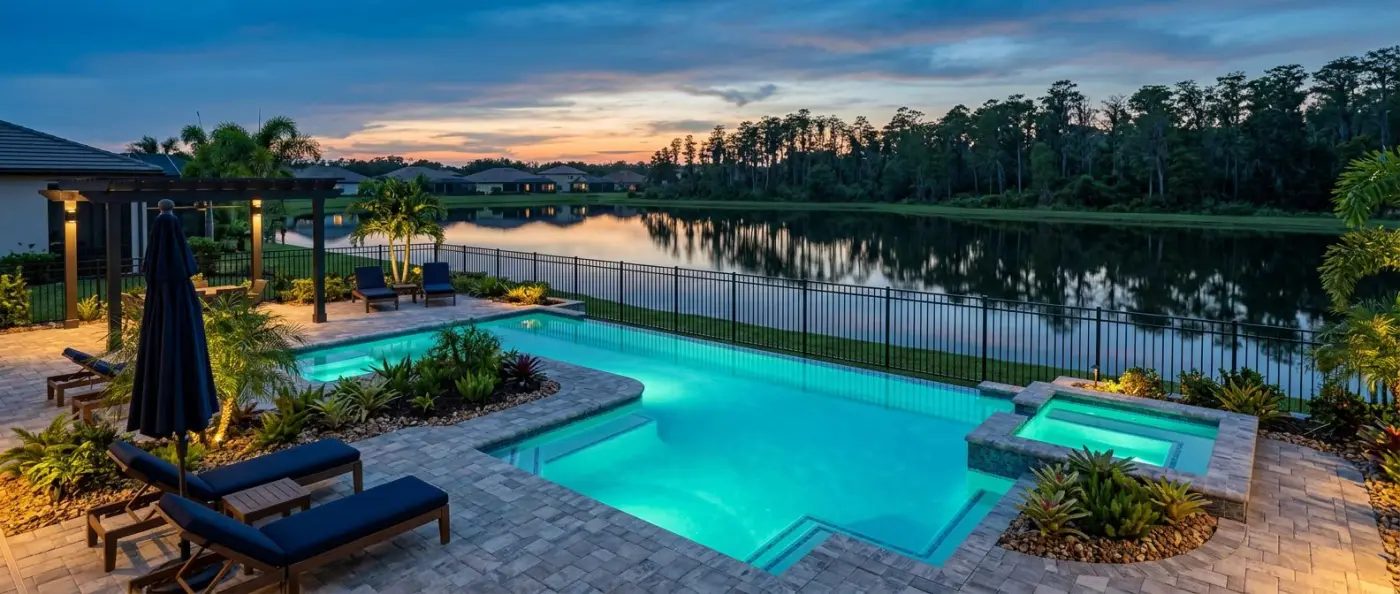
Between the lake homes off Dale Mabry, the pool homes in Wesley Chapel's newer communities and the acreage lots in between, we build a lot of pool fences. The goal is always the same: a barrier that keeps kids safe, passes inspection the first time and still looks good from the lanai.
What Florida law requires
Florida's Residential Swimming Pool Safety Act sets the baseline. A pool barrier must be at least 4 feet high on the outside, with no gaps, openings or features a young child could crawl under, squeeze through or climb over. It has to surround the pool and sit far enough from the water's edge that a child who gets past it can't fall straight in (Fla. Stat. 515.29).
Gates are where most barriers fail. Florida requires pool gates to open outward, away from the pool, and to be self-closing and self-latching, with the release on the pool side and out of a young child's reach. A house wall can be part of the barrier only if no door or window opens directly onto the pool.
For a new pool, a barrier is one of the approved safety features the pool needs to pass final inspection; the others are an approved safety cover, door and window exit alarms, self-closing door latches, or a certified pool alarm (Fla. Stat. 515.27). Your county or city inspector also applies the Florida Building Code's detailed barrier specs, so we build to those, not just the statute.
Pool fences on Lutz-area lots
Many Lutz properties back up to a lake or pond, and homeowners don't want to lose that view. Aluminum is the usual answer: it meets the barrier rules and stays nearly invisible from the house. On acreage lots where the pool sits far from the property line, a dedicated pool enclosure is often simpler and cheaper than fencing the whole yard.
Choosing a pool fence material
Aluminum is the most popular choice around Florida pools: it won't rust, it keeps the view open, and its vertical pickets are hard to climb. Vinyl works well when you want privacy around the pool deck, as long as the panel design leaves no footholds. Wood and composite can work too, built so horizontal rails sit on the pool side, not the outside where a child could use them as a ladder.
Whatever the material, we plan the layout around the gate first: where people walk, where the pool equipment sits, and which way the gate swings so it always opens away from the water.
Small details inspectors notice
Planters, AC units, pool pumps and patio furniture placed against the outside of the fence can count as climbing aids. Ground that washes out under the bottom rail after a summer storm can open a gap. A latch that sticks, or a gate that doesn't swing shut on its own, will fail. Our pool fence inspection guide walks through what to check before the inspector arrives.